When Harry Met Fanny

Harry, Fanny, Fanny, and Harry (left to right)

Pictured in the photo are two couples both named Harry and Fanny. On the left are my cousins from Providence, and on the right are my parents. At one time, the name Fanny was very popular for girls. You may remember the comedienne Fanny Brice who was the subject of the musical and movie Funny Girl.  I must have had at least six relatives named Fanny. It may have a lot of meanings and origins in names including Frances. But “Fanny” has fallen somewhat out of favor among English speakers. Click the player below to hear the Yiddish meaning of my mother’s name, “Fanny.”

Holy Shidduch!

A “shidduch” is a match made for an arranged marriage. Click the player below to hear it used in a typical sentence…

Carpe Diem in Yiddish

There are so many ways to say it. The Amish say, “We get too soon old and too late smart.” How true that is for me. I never felt I was good enough and I was always afraid to do things. And now I am too old to do stuff. Now I’m brave when it’s too late. So you must “Seize the day!” How would we say this idea in Yiddish? Click on the player below to hear what I told my daughter…

“Getzel Vert a Khoosin”

From the New York Public Library Yiddish Theater Collection

The very first live play that I went to see happened to be a musical, in the Hopkinson theater in Brownsville. I had never been to the theater in my life. I was about 10. My mother and father took me. It was a Yiddish play with Menasha Skulnik called Getzel vert a khoosin (Getzel Becomes a Bridegroom). I was so amazed. There were people singing and dancing and hulyan on stage. And I knew they were telling funny stories because everyone in the audience was laughing their heads off. That was the first time I had been to a play and I didn’t know very much Yiddish at the time. I never forgot it. I had been to the movies before. But I knew immediately that this was not like going to the movies. This was real life. It was the beginning of my awakening to the outside world.

Check this out: http://digitalcollections.nypl.org/collections/yiddish-theater-collection#/?tab=about


The Weather Is Moishe Kapoyer

This is what my mother would say when the weather was wacky like it has been on the East coast of the U.S., snowing one day and warm the next. On the internet it says that the phrase Moishe Kapoyer was coined by a humorist, B. Kovner, in The Forverts (The Forward, a Yiddish newspaper). This makes sense because my mother always read the paper. What does it mean? Moishe of course is Moses, or Morris. Kapoyer means backward or reversed. So in effect it means Moses is upside down. Whenever you are discussing something that is topsy turvy, it’s Moishe Kapoyer.

Moishe Kapoyer: Upside down Moses

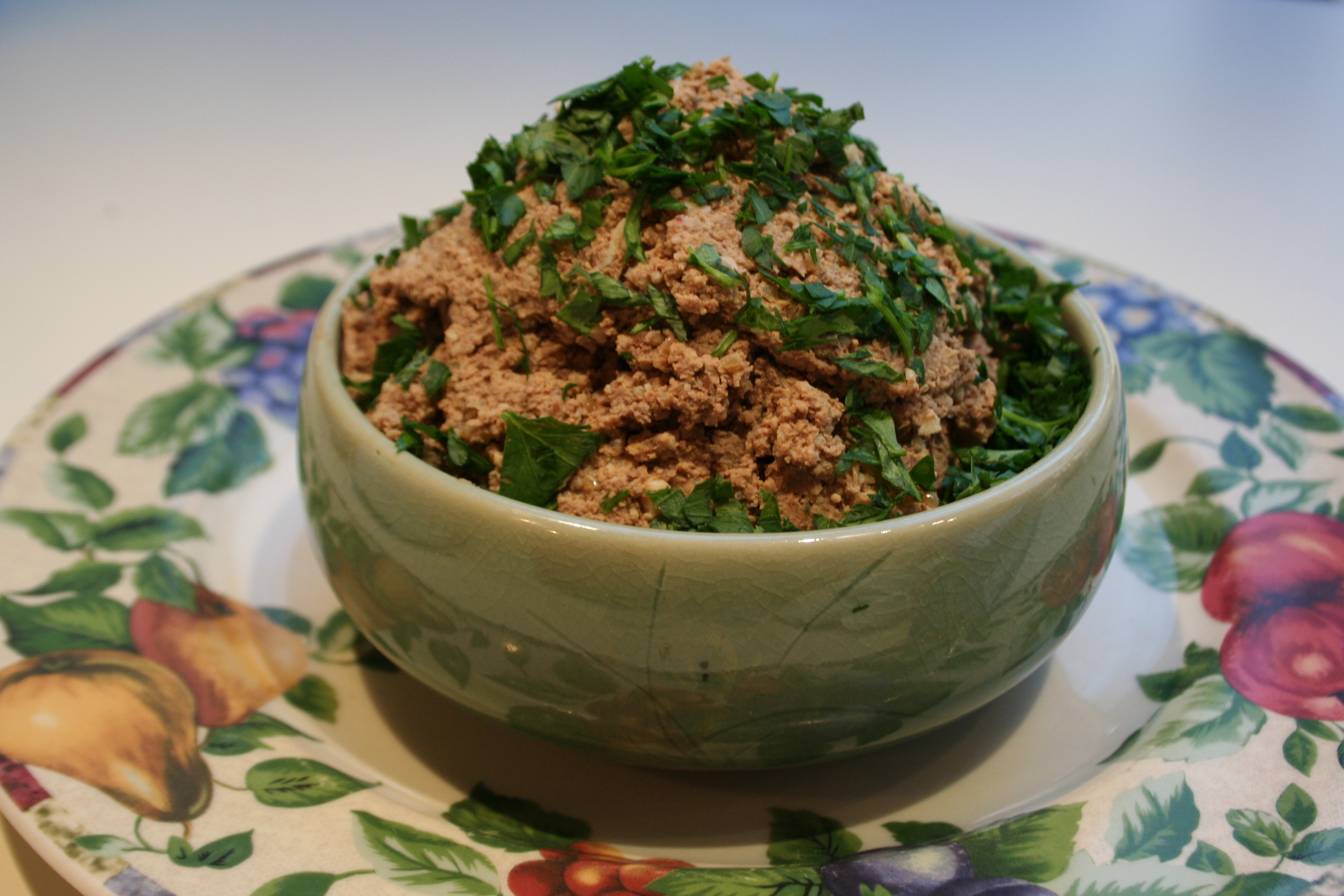
Chopped Liver: Gehakte Leber

(You can read the geshichte below the recipe.)

Chopped Chicken Liver

  • 1 to  1  1/2  pound(s) chicken livers
  • 4-5 hard-boiled eggs, or to taste*
  • 1 medium yellow onion, thinly sliced
  • 2-3 Tablespoons rendered chicken fat (shmaltz)
  • Parsley (Italian of course!)
  • Salt & pepper

Make hard-boiled eggs. Broil the livers thoroughly on a baking sheet, turning halfway through. Saute the onion in the chicken fat until the onion is golden or even somewhat browned. Place the cooked ingredients in a meat grinder or food processor. Add salt and pepper. Pulse or grind to desired texture. Garnish with parsley.

*As far as how many eggs to use, it all depends on how strong you want the liver flavor. Of course the eggs dilute or “cut” the livery flavor the more eggs you use. Also, get organic livers from organic chickens. They taste so much better and you can see that they look healthier.

Some background: This is so easy and so delicious. Chopped liver can be made with beef liver, calves liver, or chicken liver. In the old days, my mother didn’t always have a lot of chicken livers available, although she could get them from the butcher. Way back when, people used to buy whole chickens from a butcher or market, not parts.

One ingredient you must use is shmaltz, which is rendered chicken fat. This is sometimes found in the refrigerator case or freezer section. But it’s best to make it yourself from fat from a chicken. Just saute the fat and some skin till you create a nice amount of clear, melted fat. (I have seen some people use mayonnaise, but that is a terrible way to make chopped liver. But I must tell you that mayonnaise is kosher with meat and not a dairy item. Mayonnaise is just egg with oil. So the idea of never putting mayonnaise on deli or meat is just traditional taste and not a kosher problem as far as I know.)

Our Building

During the depression we decided to move in the with tenants instead of paying rent. My father owned a building with cold water flats when we moved in. It was in Bay Ridge on 69th Street between Fifth and Fourth Avenues. This was a typical Brooklyn neighborhood. It was a goyish neighborhood.

There was no heating. We had old black stoves with a lid and you put coke inside and that was how you heated and cooked. But later we bought a stove. And my father put in electricity. But before that, they would send me to a grocery store near Fourth Avenue to get the coke; they called the store “The Greek’s” even though the owner was Armenian. My mother would send me to the store and I would get the coke.

The subway was around the corner from us and two trolleys ran on our street in either direction. The boys still played stickball in between the trolleys.

Vermeer Shmeer

In Yiddish, one of the highest compliments you can pay a young woman is to say “Zee iz a meydl mit on oyringl.” She is a girl with an earring. What exactly does that mean? It’s hard to translate because it means she is exceptional in every way. Beautiful inside and out. With great energy, a real go-getter. She’s the whole package.

A meydl mit on oyringl.