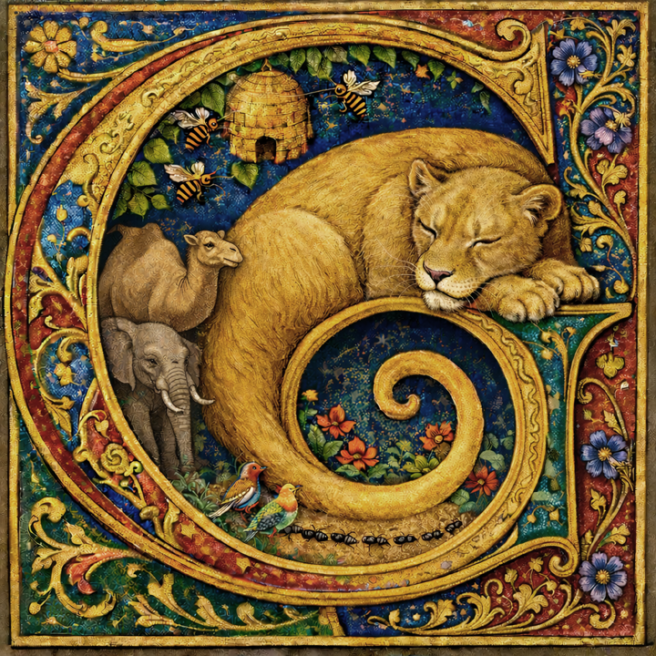
The Lioness


Give the ants their manifesto
the bees their history
let the camel describe the elephant
dromedarily

While the lioness rests on a serif raft
before executing her craft
only through hunger or boredom
does she condescend to rise
s t r e t c h
scratch out a few choice words
of conflict or change
knead them with her switchblade claws
then pause
curl up on a tuft of italic grass
in her tight cursive mass
like a capital G
to go back to sleep
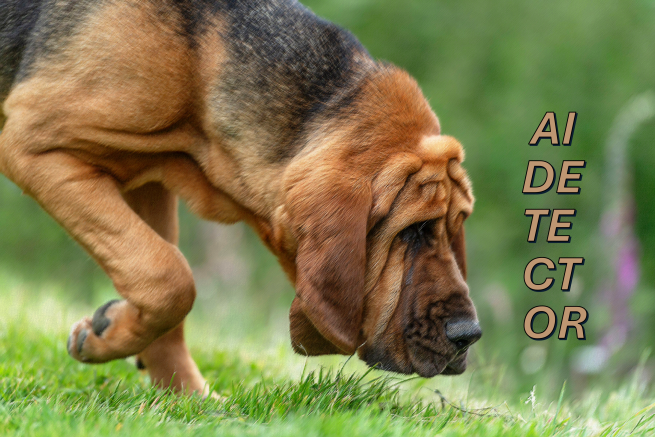
AI Detector

Image source: Alamy/Farlap

Don’t worry, the AI detector is on the scent. And he’s real.

Diacritic Mix-up

Oops! I meant to dot my “i”s and cross my “t”s.

Isle of Life

The Wind serves to turn the pages
of the book of the ages
The Garden apple has been bitten
our story cannot be unwritten

The River carves a sacred plan
to guide the family of man
A Mountain rises from the bones
of all of our ancestral homes

In the Sand our codes remain
a universe in every grain
washing underneath the Sea
of collective memory

Above us the almighty Sky
hosts its life-affirming eye
The Sun with allied asteroids
its energy cannot be destroyed

At night the Moon guards over all
the beam streams in our tiny stall
Asleep we dream till death from birth
on the isle of life on Earth

From the NFL Yiddish Playbook

New Orleans, Louisiana, USA. 9 February 2025. The Philadelphia Eagles run the tush push for a rushing touchdown by quarterback Jalen Hurts in the first half of NFL Super Bowl LIX at the Superdome. Credit: Kindell Buchanan/Alamy Live News

Somehow, Yiddish has made its way into the NFL. What’s not to love? Disclaimer: I do not have the express written consent of the National Football League to discuss this matter. But Yiddish is a lingua franca, so who needs permission?

Of course, I am talking about the strategic offensive maneuver called the tush push. Way back when, it was called the quarterback sneak. But sportscasters have settled on a more colorful way to describe this pile-up in which the quarterback plows forward with a little help from his teammates in front and behind. In Yiddish, tuchis is your rear end or posterior, according to Leo Rosten (1908–1997), the “Noah Webster” of Yiddish. From there, we get variations such as tushy or tush.

Push the tush has been an overwhelming success as an offensive play. So much so that some experts want to ban it (as do opponents of the Philadelphia Eagles who use it so effectively). Have no fear. Here are some more football plays and parlance inspired by the Yiddish language.

Bulba — A fumble. This word for potato also refers to an error in Yiddish. Perhaps this relates to the idea of dropping something like a “hot potato.”

Bulvan — A huge guy like a lineman. Let’s use it in a sentence: “A bulvan took down the ball carrier, resulting in a bulba.”

Chachma — The ruling in response to a coach’s challenge. This Yiddish word refers to wisdom. But, in keeping with the native irony of Yiddish, chachma can also mean stupidity. In this way, the result of a coach’s challenge has chachma on both sides of the ball.

Chaim Yankel — In this spectacular defensive effort, a journeyman from the practice squad is called up for the game and tackles a star player. In Yiddish, Chaim Yankel is akin to “Joe Schmo.”

Chloppeh — A rainout or muddy game, from the Yiddish for a downpour.

Chometzdik — This is not actually an on-field football move, however, in the interest of public health, please don’t eat a chometzdik hotdog if you see them being sold at the concessions stand.

Choodah moodah — In Yiddish slang, this refers to jail or prison. But, can we normalize this phrase as a way to describe a quarterback sack behind the line of scrimmage? “Choodah moodah! He got trapped in the pocket and dropped for a loss.”

Dershtikt — Piling on. Literally, to suffocate. “That tush push ended in dershtikt.”

Dray Play — A fake. This Yiddish-English portmanteau means a confusing play. “Even the camera operator fell for that dray play.”

Eingeshpart — A “stubborn” runner who refuses to be taken down, gaining extra yardage on the play. “Saquon Barkley is as eingeshpart as the great Barry Sanders was.

Farblondjet — A broken play or series can be summed up with this quintessentially Yiddish word meaning lost. “A bad snap, missed hand-off, and choodah moodah in the backfield; what a farblondjet possession.”

Farchadet — When the receiver beats the coverage. The defender, literally, got burned.

Feese — A running play; literally, feet. “Another feese to the right for a first down.”

Glik — A field goal attempt that hits the upright, but then goes through. Literally, good fortune.  “It’s up, and…it’s a glik kick for three!”

Hok a chainik — Literally, bang on a teapot. This is when the home team fans make such a racket that the visiting offense cannot hear their quarterback’s play call. “They’re hoking him a chainik and he has to waste a timeout.”

Hok ’em and brock ’em — A running play with multiple blockers. A loose translation might be “bang them and break them.”

Latke — When the ball carrier is tackled like a pancake (latke). “That bulvan flattened him on a fourth down latke.”

Meezele meizele — A running play where the ball carrier reverses to the other side of the back field, covering a lot of ground without forward progress. In Yiddish, this is a children’s rhyme about a scurrying mouse.

Megillah — A really big game like a conference championship or the Super Bowl; a big production. Literally, the book of Esther. “This whole Megillah is brought to you by….”

Potch — A tackle, a hit. “The defense wasn’t fooled by that dray play. It’s a potch for a loss.”

Pupik — An accurate pass inexcusably dropped by a receiver. Literally, the belly button. “That pupik pass hit him in the mid-section and he dropped it!”

Schneider — A shut out. In Yiddish, this word is actually used when you shut out an opponent in a game. While the surname Schneider means tailor, usage of the word during a competition may be similar to English when we say that something is “all sewn up.”   

Simcha — “Touchdown!” (A simcha is a cause for celebration.)

Zetz — A blow or punch. “According to the new rules, it isn’t kosher to give the quarterback a zetz…unless of course it takes the form of a tush push.”

A Pronunciation “Mines” Field

Don’t bother going to a “liberry” to learn English pronunciation. [Photo from “My Fair Lady” – Courtesy of CBS Broadcasting Inc.]

I am not a stickler when it comes to English usage or pronunciation. In conversation, I don’t care whether people misuse words here or there. This post may contain misplaced commas and unclear antecedents. But things have gotten scary in terms of pronunciation and I am beside myself. We have a contagion of mispronunciation that is diminishing our public discourse.

Very often I find myself watching a video and nodding affirmatively with what I think is an enlightened explanation of some economic trend or social phenomenon. Then suddenly the creator comes out with a mispronunciation so bad that it stops me in my tracks: “With big corporations buying up single-family homes and interest rates stubbornly high, people can’t find housing, ex-pecially young families.”

Huh? Ex-pecially? Dude! I was following your logic there for a bit but now you have blown your credibility and I am unfollowing you. If you don’t know how to pronounce “especially” then how can I take you seriously?

Am I missing something here? Is this a new word, perhaps a portmanteau mashup of “especially” and “for example?” Does “ex-pecially” mean a special example?

Am I losing my mind? What is going on with pronunciation? Are people learning English in text messages where they never hear the spoken word?

Spoiler alert: I am older than dirt.

Why are young people — these are native English speakers — saying PHOTOgrapher instead of phoTOgrapher? “I’m not a writer or a painter, I am a PHOTOgrapher.”

No you’re not. You’re a phoTOgrapher. And that’s a “ta” not a “toe.”

If these simple, common words are said wrong, what hope is there for notoriously hard-to-pronounce things like “applicable,” “mischievous,” “epitome,” or “nuclear.” Fuhgeddaboudit!

The “Mines” Field

Another, even more egregious case in point is “mines.” Apparently a large collective of Americans of all ages and ethnic backgrounds use “mines” as the first-person singular possessive pronoun. If something isn’t yours, ours, theirs, his or hers, then it is (wait for it) mines.

No, you didn’t hear that wrong, and the reason I know that you didn’t hear that wrong is because now people are actually spelling it with the “s.”

This language offense is not redeemable because “mines” is not just a mispronunciation (mispronounciation?), it is a totally made-up word. We’re in trouble folks. If you thought that the mere rending of our democracy by axis infiltration of fascist ideology into the American press was a problem, you ain’t seen nothin’ yet. We are losing our native tongue because we don’t talk to each other anymore. We only type messages and then create and watch streaming videos. Today, oral communication goes only one way; we send but don’t receive. But learning pronunciation is a two-way street.  

Mispronunciation of common words is a symptom of a much larger problem. We may talk at each other but we don’t listen to each other anymore. In the electronic public square, we do not have public discourse. We are making up our own language like twins speaking in tongues.

I wish it were due to cross-cultural exposure or the influence of other languages. But I’m not talking about widely accepted or regional usage. African Americans and Southerners often say “ax” instead of “ask” in a common colloquialism. Bostonians soften the “r,” similar to British English. Midwesterners harden the “r”. EX-etera. (Oy vey!)

I am talking about new, completely random, arbitrary mispronunciation that is perpetuated because people have never heard the word said right in their lives. This gradual disintegration of pronunciation may erode spoken English into extinction. The world’s fiat language may die off like the song of the Hawaiian Kaua’i ‘o’o bird. (And no, I don’t know how to pronounce that.)

Understandably, there are a lot of words that people have never heard. “Fiddlesticks, I forgot my galoshes and blunderbuss!” But the real problem is that the use of social media has replaced good old-fashioned conversation. People are learning language in a vacuum, leading to vacuous minds. Haphazard pronunciation suggests that people have never heard essential words and never will. We should worry that this means that they have never heard essential ideas and never will.

Tower of Bagel: The Word “Lox” Dates Back Millennia

Illustration generated by artificial intelligence (OpenAI, ChatGPT), 2026.

We know that smoked salmon is well preserved. But did you know that apparently our English word for it is older than most civilizations? Not only that, but the word lox is like a strand of linguistic DNA that can show relationships between ancient languages. I read it in this report from Nautilus, linked below.

https://nautil.us/the-english-word-that-hasnt-changed-in-sound-or-meaning-in-8000-years-237395

But if you think that your lox has been around too long, imagine that some English words are tens of thousands of years old according to the BBC:

http://news.bbc.co.uk/2/hi/science/nature/7911645.stm

Now that we’re on the subject, what about nova vs. lox?

Lox vs Nova

No-Ice-Cream-Maker Ice Cream

Vanilla custard, chocolate, peach, and other flavors of ice cream can be made using a freezer tray. (See the last card in each recipe below for the method to use if you don’t have an ice cream maker.)

Snowbirds (Haiku)

autumn geese
flying arrow
pointed south

Image composition based on Hokusai’s Inume Pass in Kai Province, courtesy of HimalayasGraphic