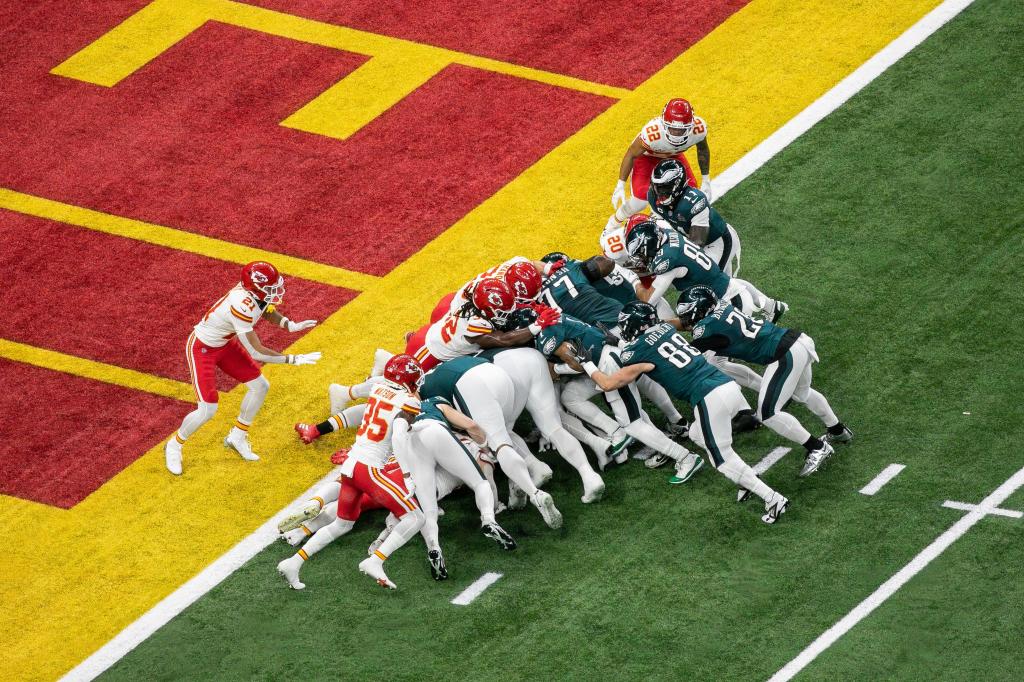
New Orleans, Louisiana, USA. 9 February 2025. The Philadelphia Eagles run the tush push for a rushing touchdown by quarterback Jalen Hurts in the first half of NFL Super Bowl LIX at the Superdome. Credit: Kindell Buchanan/Alamy Live News
—
Somehow, Yiddish has made its way into the NFL. What’s not to love? Disclaimer: I do not have the express written consent of the National Football League to discuss this matter. But Yiddish is a lingua franca, so who needs permission?
Of course, I am talking about the strategic offensive maneuver called the tush push. Way back when, it was called the quarterback sneak. But sportscasters have settled on a more colorful way to describe this pile-up in which the quarterback plows forward with a little help from his teammates in front and behind. In Yiddish, tuchis is your rear end or posterior, according to Leo Rosten (1908–1997), the “Noah Webster” of Yiddish. From there, we get variations such as tushy or tush.
Push the tush has been an overwhelming success as an offensive play. So much so that some experts want to ban it (as do opponents of the Philadelphia Eagles who use it so effectively). Have no fear. Here are some more football plays and parlance inspired by the Yiddish language.
Bulba — A fumble. This word for potato also refers to an error in Yiddish. Perhaps this relates to the idea of dropping something like a “hot potato.”
Bulvan — A huge guy like a lineman. Let’s use it in a sentence: “A bulvan took down the ball carrier, resulting in a bulba.”
Chachma — The ruling in response to a coach’s challenge. This Yiddish word refers to wisdom. But, in keeping with the native irony of Yiddish, chachma can also mean stupidity. In this way, the result of a coach’s challenge has chachma on both sides of the ball.
Chaim Yankel — In this spectacular defensive effort, a journeyman from the practice squad is called up for the game and tackles a star player. In Yiddish, Chaim Yankel is akin to “Joe Schmo.”
Chloppeh — A rainout or muddy game, from the Yiddish for a downpour.
Chometzdik — This is not actually an on-field football move, however, in the interest of public health, please don’t eat a chometzdik hotdog if you see them being sold at the concessions stand.
Choodah moodah — In Yiddish slang, this refers to jail or prison. But, can we normalize this phrase as a way to describe a quarterback sack behind the line of scrimmage? “Choodah moodah! He got trapped in the pocket and dropped for a loss.”
Dershtikt — Piling on. Literally, to suffocate. “That tush push ended in dershtikt.”
Dray Play — A fake. This Yiddish-English portmanteau means a confusing play. “Even the camera operator fell for that dray play.”
Eingeshpart — A “stubborn” runner who refuses to be taken down, gaining extra yardage on the play. “Saquon Barkley is as eingeshpart as the great Barry Sanders was.
Farblondjet — A broken play or series can be summed up with this quintessentially Yiddish word meaning lost. “A bad snap, missed hand-off, and choodah moodah in the backfield; what a farblondjet possession.”
Farchadet — When the receiver beats the coverage. The defender, literally, got burned.
Feese — A running play; literally, feet. “Another feese to the right for a first down.”
Glik — A field goal attempt that hits the upright, but then goes through. Literally, good fortune. “It’s up, and…it’s a glik kick for three!”
Hok a chainik — Literally, bang on a teapot. This is when the home team fans make such a racket that the visiting offense cannot hear their quarterback’s play call. “They’re hoking him a chainik and he has to waste a timeout.”
Hok ’em and brock ’em — A running play with multiple blockers. A loose translation might be “bang them and break them.”
Latke — When the ball carrier is tackled like a pancake (latke). “That bulvan flattened him on a fourth down latke.”
Meezele meizele — A running play where the ball carrier reverses to the other side of the back field, covering a lot of ground without forward progress. In Yiddish, this is a children’s rhyme about a scurrying mouse.
Megillah — A really big game like a conference championship or the Super Bowl; a big production. Literally, the book of Esther. “This whole Megillah is brought to you by….”
Potch — A tackle, a hit. “The defense wasn’t fooled by that dray play. It’s a potch for a loss.”
Pupik — An accurate pass inexcusably dropped by a receiver. Literally, the belly button. “That pupik pass hit him in the mid-section and he dropped it!”
Schneider — A shut out. In Yiddish, this word is actually used when you shut out an opponent in a game. While the surname Schneider means tailor, usage of the word during a competition may be similar to English when we say that something is “all sewn up.”
Simcha — “Touchdown!” (A simcha is a cause for celebration.)
Zetz — A blow or punch. “According to the new rules, it isn’t kosher to give the quarterback a zetz…unless of course it takes the form of a tush push.”
Don’t bother going to a “liberry” to learn English pronunciation. [Photo from “My Fair Lady” – Courtesy of CBS Broadcasting Inc.]
I am not a stickler when it comes to English usage or pronunciation. In conversation, I don’t care whether people misuse words here or there. This post may contain misplaced commas and unclear antecedents. But things have gotten scary in terms of pronunciation and I am beside myself. We have a contagion of mispronunciation that is diminishing our public discourse.
Very often I find myself watching a video and nodding affirmatively with what I think is an enlightened explanation of some economic trend or social phenomenon. Then suddenly the creator comes out with a mispronunciation so bad that it stops me in my tracks: “With big corporations buying up single-family homes and interest rates stubbornly high, people can’t find housing, ex-pecially young families.”
Huh? Ex-pecially? Dude! I was following your logic there for a bit but now you have blown your credibility and I am unfollowing you. If you don’t know how to pronounce “especially” then how can I take you seriously?
Am I missing something here? Is this a new word, perhaps a portmanteau mashup of “especially” and “for example?” Does “ex-pecially” mean a special example?
Am I losing my mind? What is going on with pronunciation? Are people learning English in text messages where they never hear the spoken word?
Spoiler alert: I am older than dirt.
Why are young people — these are native English speakers — saying PHOTOgrapher instead of phoTOgrapher? “I’m not a writer or a painter, I am a PHOTOgrapher.”
No you’re not. You’re a phoTOgrapher. And that’s a “ta” not a “toe.”
If these simple, common words are said wrong, what hope is there for notoriously hard-to-pronounce things like “applicable,” “mischievous,” “epitome,” or “nuclear.” Fuhgeddaboudit!
The “Mines” Field
Another, even more egregious case in point is “mines.” Apparently a large collective of Americans of all ages and ethnic backgrounds use “mines” as the first-person singular possessive pronoun. If something isn’t yours, ours, theirs, his or hers, then it is (wait for it) mines.
No, you didn’t hear that wrong, and the reason I know that you didn’t hear that wrong is because now people are actually spelling it with the “s.”
This language offense is not redeemable because “mines” is not just a mispronunciation (mispronounciation?), it is a totally made-up word. We’re in trouble folks. If you thought that the mere rending of our democracy by axis infiltration of fascist ideology into the American press was a problem, you ain’t seen nothin’ yet. We are losing our native tongue because we don’t talk to each other anymore. We only type messages and then create and watch streaming videos. Today, oral communication goes only one way; we send but don’t receive. But learning pronunciation is a two-way street.
Mispronunciation of common words is a symptom of a much larger problem. We may talk at each other but we don’t listen to each other anymore. In the electronic public square, we do not have public discourse. We are making up our own language like twins speaking in tongues.
I wish it were due to cross-cultural exposure or the influence of other languages. But I’m not talking about widely accepted or regional usage. African Americans and Southerners often say “ax” instead of “ask” in a common colloquialism. Bostonians soften the “r,” similar to British English. Midwesterners harden the “r”. EX-etera. (Oy vey!)
I am talking about new, completely random, arbitrary mispronunciation that is perpetuated because people have never heard the word said right in their lives. This gradual disintegration of pronunciation may erode spoken English into extinction. The world’s fiat language may die off like the song of the Hawaiian Kaua’i ‘o’o bird. (And no, I don’t know how to pronounce that.)
Understandably, there are a lot of words that people have never heard. “Fiddlesticks, I forgot my galoshes and blunderbuss!” But the real problem is that the use of social media has replaced good old-fashioned conversation. People are learning language in a vacuum, leading to vacuous minds. Haphazard pronunciation suggests that people have never heard essential words and never will. We should worry that this means that they have never heard essential ideas and never will.
Illustration generated by artificial intelligence (OpenAI, ChatGPT), 2026.
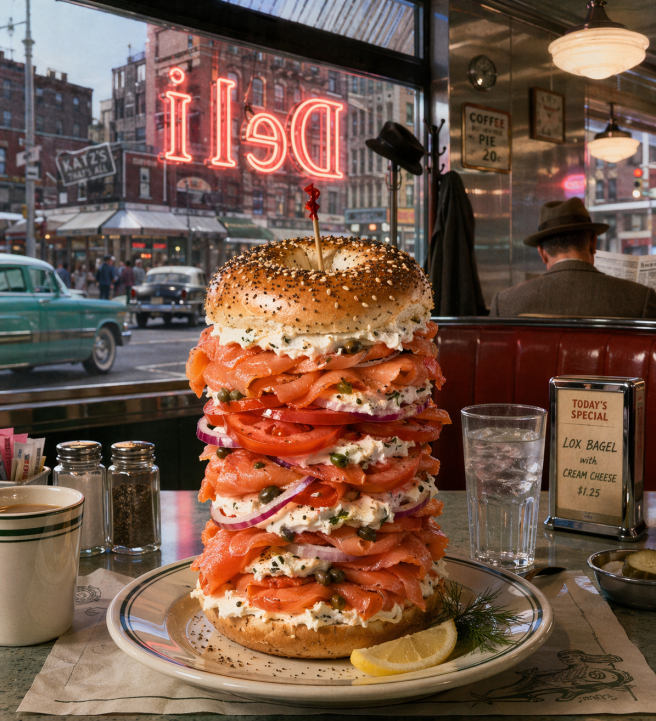
We know that smoked salmon is well preserved. But did you know that apparently our English word for it is older than most civilizations? Not only that, but the word lox is like a strand of linguistic DNA that can show relationships between ancient languages. I read it in this report from Nautilus, linked below.
Vanilla custard, chocolate, peach, and other flavors of ice cream can be made using a freezer tray. (See the last card in each recipe below for the method to use if you don’t have an ice cream maker.)
I am pretty good with technology. It all started with the Commodore 64 and I have tried to keep up ever since. It’s not that I know so much about technology. I’m just not afraid to press buttons till I get what I want. The goal is, and if this were a movie it would be a classic line of dialog, Never let the machine win. So it was especially humiliating when I locked my keyless entry fob in the trunk of my new car when I first got it.
My daughter and I had just shared a lovely meal. It was the sort of evening you flash back to when remembering the simple joy of being with those you love. We swapped eyeglasses and ate off each other’s plates in the kind of on-screen actions that establish the relationship between characters.
But the night was about to go from “It’s a Wonderful Life” to “The Matrix.”
After dinner, we went to the car. I opened the trunk just by touching it; this was doable because I had the key fob in my purse. I put my purse in the trunk as did my daughter. And here we would cut to a shot of our purses strewn in the trunk because it is essential to the plot that we don’t have cab fare.
You see, as long as the fob is on your person, you have security access to open the doors and operate the vehicle. So I figured putting the fob in the trunk was covered.
Not so fast, Private Benjamin.
Before I closed the trunk, my daughter said ominously, “Get the key.”
Next came my famous line, “We don’t need no stinking key.” (Sound effect of trunk slamming shut.)
A slow-motion sequence played in my mind with garbled sound as I went to the driver’s door and pulled the handle. It normally releases to a sequence of lights, beeps, and screens like something out of “War Games.” But this time…nothing. I was locked out of my brand new keyless car. The access code, which can be entered on the exterior door panel at times like this, was stored in my smart phone—you guessed it—in my purse. In that moment my phone was smarter than I was. The code eluded me and I didn’t have on my ruby slippers.
Fortunately, we used one technology to save us from another. My daughter had her phone in her coat pocket. I called the Ford dealer to get the access code. He asked for my Social Security number and the cat’s name. But when he told me the code my face contorted into a quizzical double take.
“Is that some kind of dealer master code?” I asked.
“No, lady, that is the only entry code for your car,” he said, evidently forgetting that he was speaking with Sigourney Weaver.
I instantly knew that the number he gave me was wrong. Like Jason Bourne, I recalled that my real code was an even number that contained two prime numbers followed by an integer and its square. I just couldn’t remember what those numbers were.
I fatalistically entered the dealer’s code into the car door as violins from the “Psycho” soundtrack screeched in my head. I yanked the locked door handle to no avail and did a Harold Lloyd impression, running around the car trying to open every door.
At this point I was in a dream sequence with my own mother invoking one of those Yiddish expressions that sounds like she is about to spit. “It’s bashert. It’s destiny,” I heard her say in a gauzy sepia tone. Suddenly, her face morphed into Obi-Wan Kenobi. The force would soon be with me. The dealer was on his way to take us home and retrieve the other key fob. (Like Meg Ryan’s fastidious Sally, I had put a lockbox on the front door so we could always get into the house.)
I waited for our ride with the resolve of Sarah Connor. The machine would not win; it was a tie. The power of technology equaled my mastery of it. But why did this ill-fated episode happen? I imagined, in menacing handheld footage, that the delay was for some greater good. Would we have gotten into an accident if not for this diversion in our travels through Middle-earth?
“It’s bashert. It’s bashert,” I heard in an echo chamber. As God is my witness, I will never leave the key fob in the trunk again.
If the nation is divided, blame computing. A nation digitized against itself cannot stand. When we invented the computer we started down a slippery slope by reducing information to data—a series of binary on/off switches. Everything became zero or one, plus or minus, yes or no…us or them.
In the process of digitizing information, we have also distilled knowledge and understanding to extremes. Once you express ideas in absolutes, the next step is to think that way. Life imitates information. So now we have red states and blue states and politicians pandering to their “base,” which is not really the base at all but the fringe. We’ve got a left wing and right wing but the body politic is missing its core.
Remember the proverbial pendulum that would dependably swing back when things got out of hand? That grandfather clock has been replaced with a digital readout. It’s not just a metaphor. Technology changes how we view information. Sure, a digital watch tells exact time—it’s 11:47:03. But precision is no substitute for context. The reliable hands of an analog clock pointed to the hour in relation to the day. We saw what time it was and what time it wasn’t.
No more. Today we calculate but we don’t figure. We advance but don’t progress. Taking things to extremes, the Internet connects like-minded people so they can communicate, commiserate, coordinate, instigate. This gives radical causes a louder voice. The media comply with publicity in a quest to sensationalize events into big stories. Everything achieves “controversy” status. We used to have talking heads but now they shout.
Through this polarized filter we see the world as a snapshot but not the whole picture, like a digital photo distorted by poor resolution.
Why do we reduce, produce, record and convey information in this way? Because it’s easy, fast and cheap. Where will it end? We need only look at our digital devices to know: We’re going to crash. That’s because digital and electronic systems function perfectly or not at all. It’s everything or nothing. A mechanical system on the other hand, like an old model automobile, undergoes a graceful degradation. It gradually becomes less efficient until it peters out. In the past, you could always prop the carburetor open with a pencil. But in the electronic world of black boxes, we have no role in how the car runs and little advance warning before it dies completely. This total system failure is what engineers call catastrophic degradation.
Depending on machines is frightening enough. Let’s not allow how we think to depend on them too.
I want to have a little talk with you about the birds and the bees. As you know, right now, your body politic is going through an awkward transition that brings with it strange desires, excitement and also feelings of uncertainty.
You may have noticed changes taking place that you didn’t expect and don’t understand. I want you to know that everything is going to be okay. We all go through this and it is perfectly normal, and in many ways a beautiful thing.
Remember when you were little and I told you that Republicans were made of frogs and snails and puppy dog tails, and Democrats were made of sugar and spice and everything nice? Well sometimes these two very different types of people come together and even go out with each other. I know you think this sounds pretty gross and you’re right to make that face.
But the reason we come together is to create a new nation, conceived in liberty. Remember when Fluffy had kittens? It’s the same idea. You see, it’s a natural cycle. Every four years we have an election. Don’t be embarrassed. These are the facts of life. In the election the Democrat meets the Republican. Then, a few months later, there’s a new birth of freedom as your Uncle Abe would say.
I know it all sounds very weird right now. When you grow up, after you are old enough to register to vote, you will meet a candidate and fall in love and make a new nation together too. I guess what I’m trying to say is, even though it doesn’t seem like it now, you will get through these growing pains, and when you do, things will get a lot better. I promise.
So now you know where you came from—you came from people. If you have any questions, ask your forefathers.